The sheer quality and volume of output from IAB Tech Lab in late 2025 and already in 2026 has been such that we recently wrote a quick summary of the six updates which we felt are the most exciting and important for the Australian industry to be aware of through 2026.
Whilst there are other projects that are obviously very important, given the timing it’s the Agentic initiative and the associated roadmap which is currently grabbing the most attention. Hence we wanted to write a simple explainer to introduce the project, build awareness and provide an update on how we intend to support and align with the roadmap as it evolves. Please feedback as you see fit.
A Standards-Driven Roadmap to an AI-Enabled Future
IAB Tech Lab’s Agentic Advertising Initiative, unveiled in early 2026, is a foundational project and our industry’s most comprehensive attempt at ensuring that the transition towards us all leveraging the capabilities of agentic AI doesn’t simply descend into complete chaos.
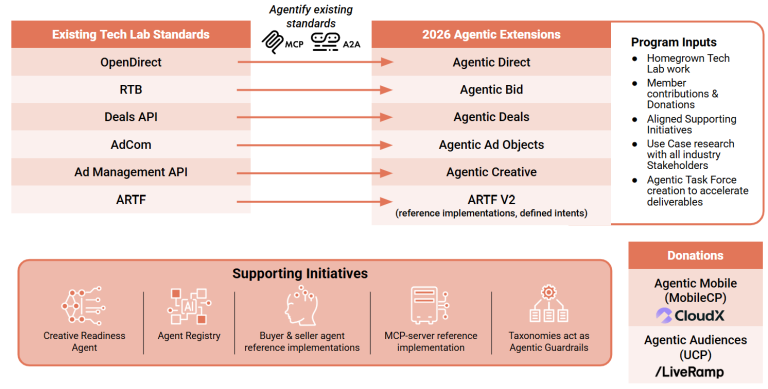
Our industry has already defined the language of advertising through Tech Lab standards such as OpenDirect and OpenRTB, which have been in use for over a decade. So the approach is very pragmatic, rather than reinventing the wheel, the Tech Lab is essentially now working to ‘agentify’ the standards that already facilitate billions of transactions daily by layering on the protocols and guardrails necessary for machines to meaningfully and effectively negotiate with other machines.
Why Standards Matter in an Agentic World
Autonomous agents perform best when operating within structured environments with clearly defined schemas. The two key agentic frameworks which are most adopted and continue to gain traction are the Model Context Protocol (MCP) and Agent-to-Agent (A2A) protocols. These both thrive on standardised, referenceable contexts – so Tech Lab’s response accordingly has been to look at working to embed these two key agentic protocols (MCP & A2A) with our existing industry standards and specifications that have long weathered the relentless storms of ad fraud debates, supply path optimisation headaches, transparency demands and other concerns. The challenge now is to make the ‘agentified’ standards readily accessible to autonomous agents and empower the MCP & A2A protocols with the referenceable context required to perform actions.
When a programmatic trader evaluates inventory today, they are relying upon mental models established from years of industry conventions. They know what a Deal ID represents, understand the taxonomy of audience segments and can recognise the signals for brand safety. An AI agent requires the same levels of context, but needs it made available in a machine-readable format, instantly accessible and consistently applied across the ecosystem.
MCP and A2A
Before we look at the proposed framework itself, we should quickly summarise the key agentic frameworks being referenced.
Launched by Anthropic in late 2024, MCP is an open protocol that lets AI models securely connect to external data sources and tools through a common interface. It functions as a USB-C for AI – one standard port that can work with any compatible device. The protocol defines three core capabilities – Tools (actions the AI can take), Resources (data the AI can access), and Prompts (predefined templates for common interactions). This means instead of copy-pasting campaign data into a chat interface, your media planning agent can simply query your data warehouse directly, through a standardised connection.
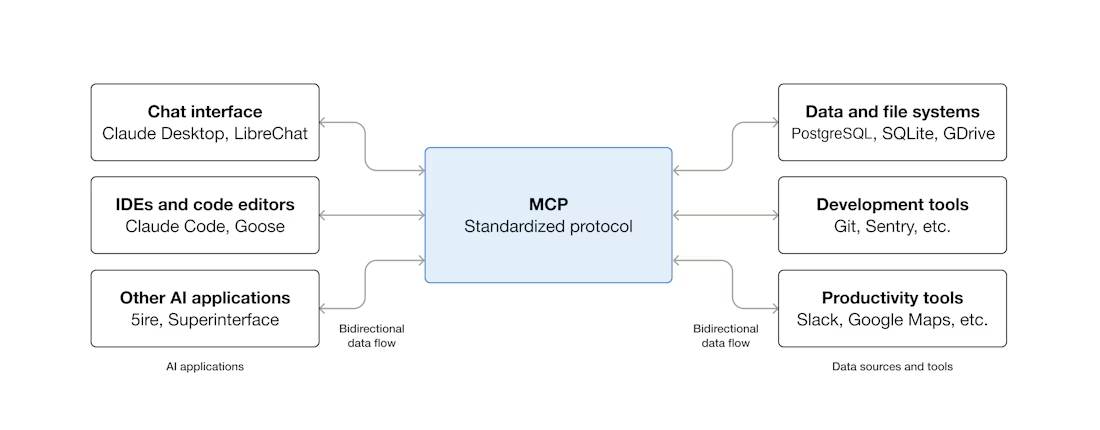 image source: modelcontextprotocol.io
Launched by Google in April 2025, A2A lets agents from different vendors or frameworks discover one another, negotiate tasks, and exchange results enabling interoperability. A2A treats all agents as opaque, in that they can collaborate without exposing any proprietary logic, memory, or tool implementations.
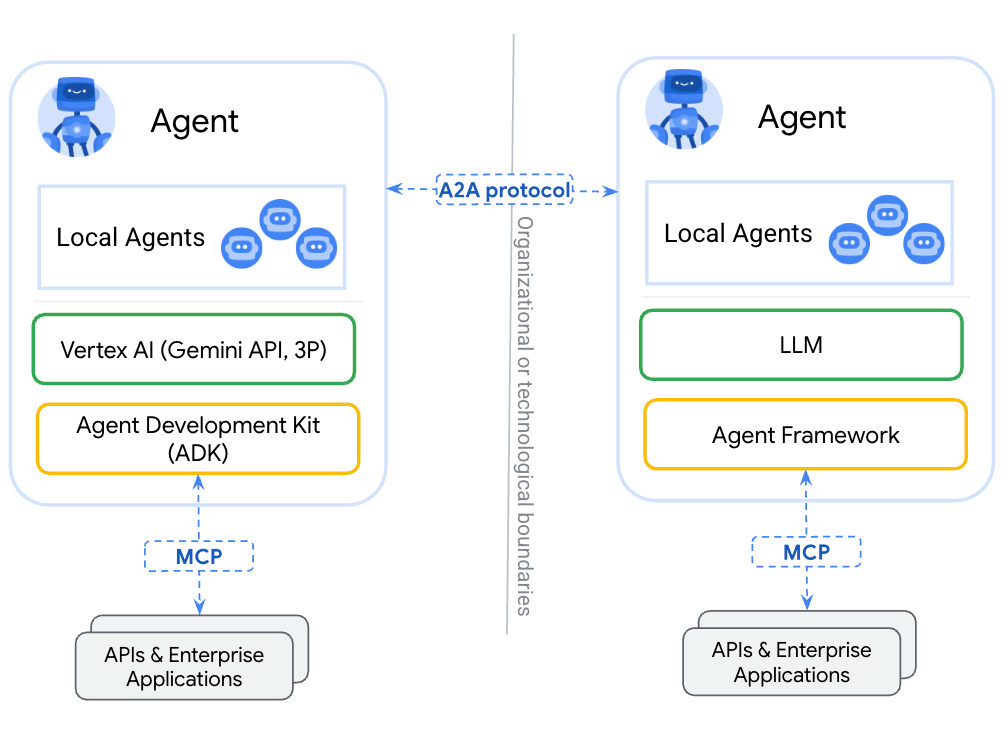
image source: a2a-protocol.org
The Core Technical Framework
The Agentic Advertising Initiative rests on several interconnected technical pillars, each designed to solve specific requirements within the agent-to-agent workflow.
The Agentic Real-Time Framework (ARTF) is core as it defines the foundation for implementing agent services that operate within a host platform and the orchestrating platform can call directly to accomplish any shared goals. Released for public comment in late 2025, ARTF defines how service agents can operate within host platforms, enabling the delegation of bidstream processing in a consistent manner with minimal latency. The framework uses containerised deployments that allow service providers to package their offerings once and deploy them to any standard-compliant platform. This means identity resolution agents, fraud detection agents, or segmentation activation agents can be integrated into the real-time bidding flow without each platform requiring any bespoke implementations.
The ARTF specification is deliberately use-case agnostic and is designed to support any of the intents that can be defined as new use cases emerge. Whether that’s an agent handling pre-impression fraud detection or dynamically adjusting audience segments based upon real-time signals, the framework provides the container runtime behaviour standards and API definitions that can enable reliable, protected bidstream attributes. We are expecting to see the v1 of ARTF finalised shortly (as of 11th Feb 2026) and a v2 proposal published before the end of March 2026 with improvements on security and interoperability.
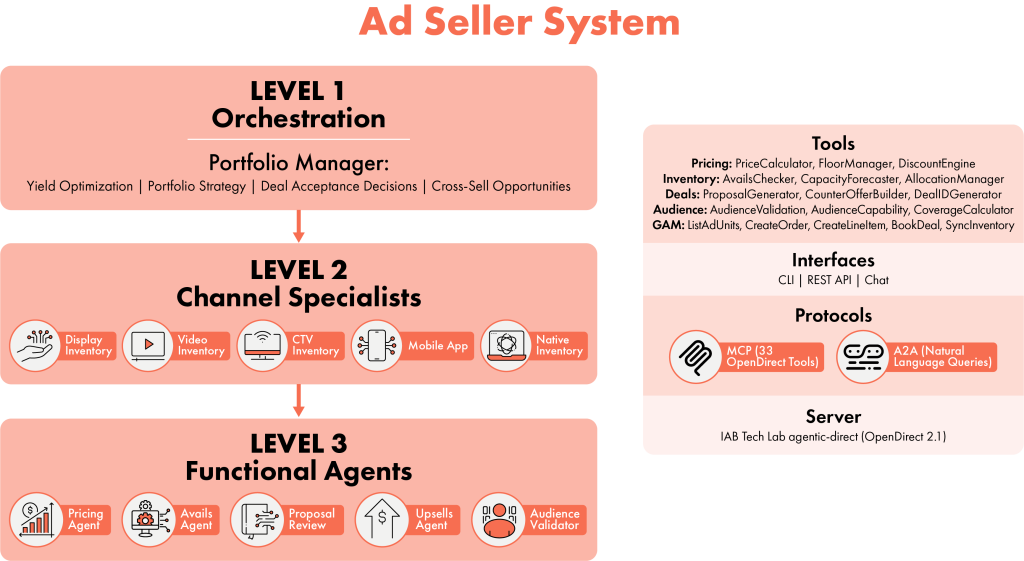
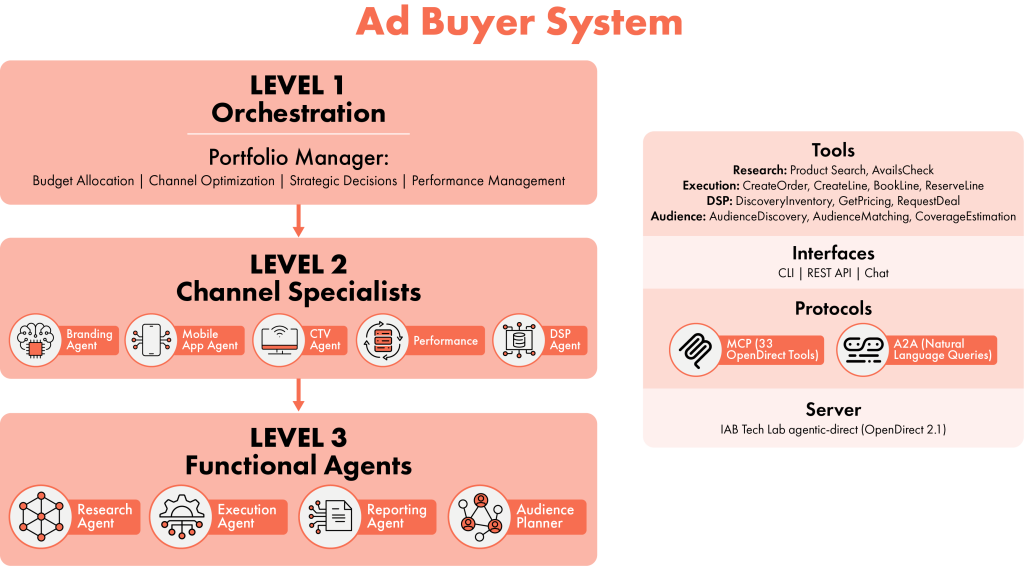
Agentic Direct and the Deals API address the direct transaction layer. The OpenDirect specifications which enable automated buying and selling with integration into publisher ad servers, has been extended with an Agentic Direct implementation. This will allow buyer agents to discover inventory and negotiate deals directly with seller agents, thereby automating the traditional workflows that currently consumes countless hours of human effort.
For programmatic channels (particularly PMPs), the new Deals API enables agents to communicate deals with SSPs and DSPs seamlessly. These deals can be enriched using the ARTF standard, or by the platforms directly, providing the context that agents require when evaluating opportunities against campaign objectives and any pre-defined KPIs.
Trust Through Transparency: The Agent Registry
One of the most significant components (launching in early March 2026) will be the Agent Registry. This is a free, open registry within the IAB Tech Lab’s Tools Portal that will allow companies to register their agents and operate within a transparent, shared ecosystem. The intention here is to address the foundational challenge in any agentic system in terms of knowing exactly who you are dealing with.
In the current programmatic landscape, we have ads.txt and sellers.json to validate supply-side participants. The buyers.json and DemandChain specifications provide equivalent transparency on the buy side. The Agent Registry now extends this concept in a consistent manner to autonomous agents, creating an accountability layer that will be critical as more transactions occur without direct human oversight.
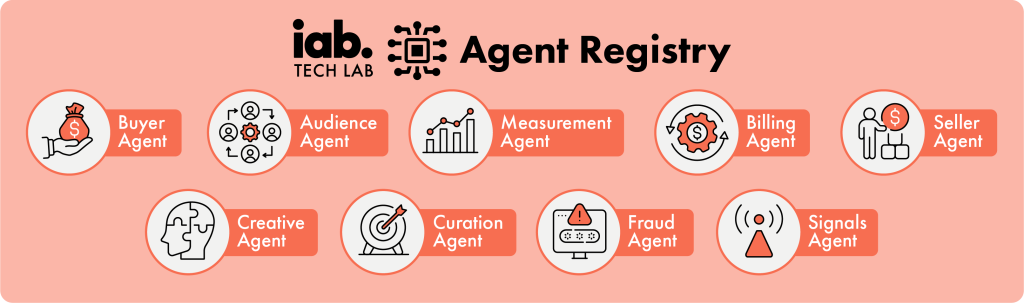
As mentioned, the registry will operate through the Tech Lab Tools Portal and is open to all to ensure universal adoption of trust mechanisms so important to our industry.
The Taxonomy Layer: Guardrails for Agentic Decision-Making
For agents to negotiate effectively, they need a shared vocabulary. The IAB Tech Lab’s 4 existing taxonomies (Content, Ad Product, Audience & Privacy) become critical guardrails within agentic environments to support buyer agents evaluating publisher inventory.
Additionally AdCOM (Advertising Common Object Model) underpins all of the sets of objects that power OpenRTB, and resultingly provides the essential structured data formats that enable communication. By extending AdCOM for agentic use cases, the Tech Lab ensures that the rich context required for sophisticated media buying decisions can be exchanged between autonomous systems.
Two existing specifications have been renamed for (clarity), the User Context Protocol (UCP) donated by LiveRamp is now Agentic Audiences, and MobileCP (donated by CloudX) is now Agentic Mobile. Both provide privacy-preserving extensions for their respective domains
A visual representation of the overall workflow is below:
Practical Implications for our Industry
So what does this potentially mean in practice for the operational practitioners in our industry?
- For publishers – this initiative promises a more efficient monetisation of supply. Agentic systems that can instantly evaluate and bid upon impressions based on sophisticated campaign parameters should mean fewer unsold impressions and improved yield management. The direct negotiation capabilities enabled by Agentic Direct and the extended Deals API should revitalise the direct sales channel, automating activation & execution whilst allowing more time on improving products and preserving the strategic relationship management that drives so much value for publishers.
- For advertisers and agencies – the automation of media planning and buying workflows promises to redirect human effort from fiddly operational executions to more strategic decision-making. The current reality involves skilled media professionals spend too many hours navigating ad-hoc DSP interfaces, cross-referencing spreadsheets, and manually adjusting campaign parameters. The hope is that this process evolution can mature towards a trading model where agents handle the mechanical complexities allowing humans to focus more on creative strategy, audience insights and strategy.
- For ad tech vendors – the standardised frameworks can reduce the relentless burden of integrations and vendors are recommended to commit to adapting their existing implementations to also support agentic extensions. Rather than building bespoke connectors for hundreds of potential agentic partners, vendors can implement the ARTF specifications once and gain full interoperability across the agentic ecosystem. The container-based deployment model in ARTF means that service providers can focus on their unique value propositions whilst offloading operational scaling concerns to various host platforms.
The Road Ahead
The IAB Tech Lab’s timeline is aggressive but realistic and we expect this roadmap to evolve quickly, and hence locally we will be leaning on a number of our different councils and working groups to support these efforts here in Australia.
Strategically we’ll be leaning on our Executive Technology Council to help build awareness and provide guidance on the potential benefits. Then we have an AI Working Group that can assist in reviewing some of the key agentic requirements from a digital advertising perspective. Lastly (and potentially most critically) we have a ‘Standards & Guidelines’ council (S&G) comprised of Ad Ops, Tech Ops and programmatic experts that can work to test and collaboratively pilot agentic tools for both buyers and sellers. We will be liaising directly with the relevant IAB Tech Lab product leads throughout this process.
In terms of timings, the Agent Registry should be opens by early March and the ARTF specifications are now moving through public comment toward finalisation. The reference implementations of Agentic Direct and the extended Deals API are already available for testing.
Tech Lab’s Agent Labs is the next step in H1 to collaboratively work to extend what works, embed industry knowledge into machine-readable formats, and create the trust mechanisms necessary for autonomous negotiation. From the effort being invested and planning involved, it’s now clear that is not simply a noisy theoretical exercise as there are production-ready tools being built to help enable our industry for a transition that is already beginning.
Lastly, it’s worth reminding ourselves that the promise of this project is not one of a dystopian future where AI handles everything and human skills become obsolete. Rather, it promises something more practical – a standardised foundation that allows our industry to capture the efficiency gains of autonomous systems without sacrificing the transparency, accountability, and trust that digital advertising needs.
If you’re implementing agentic tools or have questions about the roadmap we’ll be updating everyone locally and openly reviewing progress at our AdTech & Ops event in Melbourne on Tuesday 2nd June 2026. Hopefully see you there!
To view a webinar from IAB Tech Lab launching this critical initiative please see below: