IAB Australia’s Executive Technology Council is currently working on a refreshed AdTech Transparency Framework for our local market, which remains a critical topic for our industry with the prevalence of programmatic as a buying mechanism for online advertising globally.
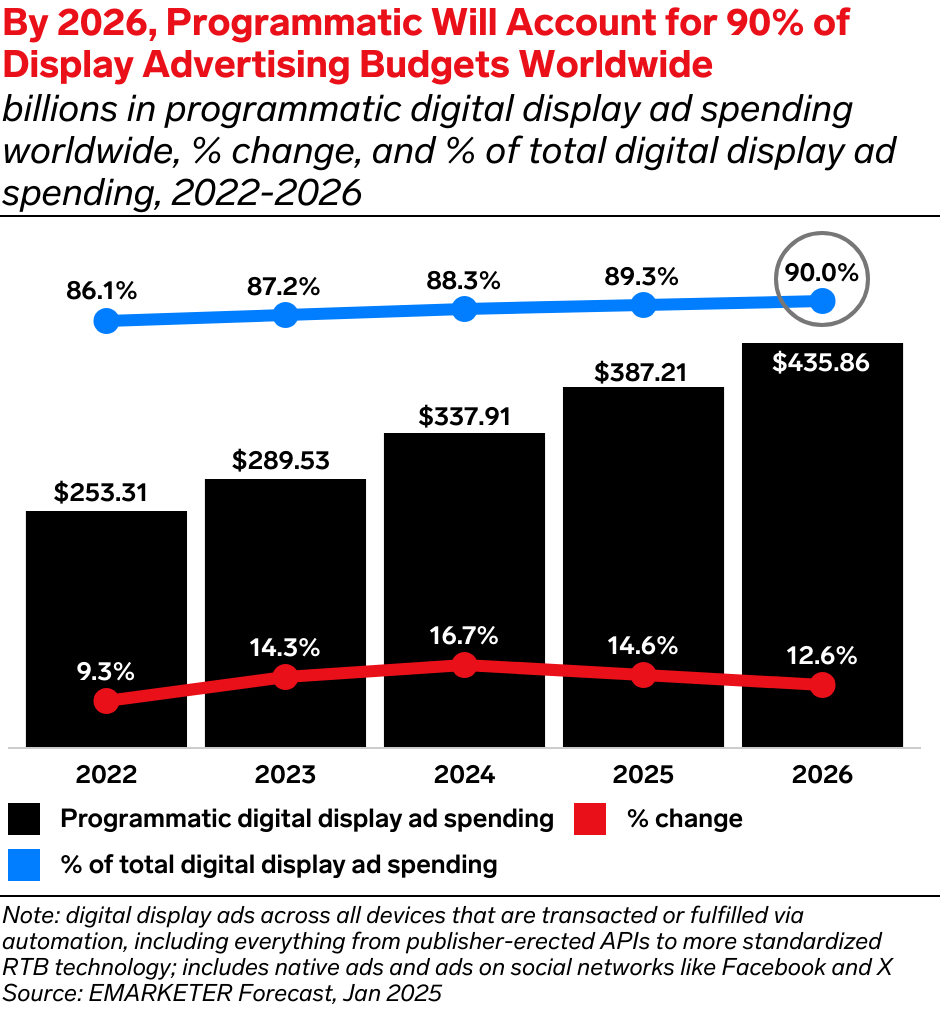
In fact for good old display forecasts for 2026 are now at 90% of global budgets according to EMARKETER (see below). Australia’s percentage is slightly different as we still see a fair amount of IO-based buying (to review local revenue trends click here).
Transparency is a sensitive topic as ultimately it often boils down to trust, and in relation to how advertising technology vendors provide their services can be split into two areas of focus:
- Visibility over the details, contracts, commercial arrangements, partnerships and margins associated with any digital ad campaigns and all of the participants involved.
- Visibility over the paths of supply and demand and the intermediaries involved in enabling the related operational processes, particularly with auction-based programmatic digital ad campaigns.
This article is entirely focused on the second (B) area of focus, and whilst it may help solve for some of the requirements of the first (A) area of focus – we are not reviewing how the various commercial arrangements between different entities may be structured.
Instead we will solely focus on the latest recommendations and standards available for providing improved transparency in how digital programmatic ad auctions are managed and executed.
Plenty of noise is relentlessly being generated by scathing reports on transparency by the likes of ISBA in the UK (click here) and more recently the ANA in the US (click here) which undermine trust, particularly with headlines claiming billions of dollars being wasted. These studies still largely rely upon reconciling log-level data files, interpreting the nuances of different platforms, automating as many of the collection processes as possible and establishing logical rules based upon traditional auditing practices.
With these approaches it still feels as if some of the basic recommendations made over 5 years ago (click here) are not yet standard practice, particularly with regards to these very noisy transparency studies.
Hence the intention of this article, to provide both an explainer and an update on programmatic transparency standards. We’ll start by looking at the IAB Tech Lab’s supply-side transparency specifications that work together to provide buyers with full and complete visibility into the programmatic supply chain, and then we’ll review the recently released draft MRC Digital Advertising Auction Transparency Standards.
We have also included some practical recommendations for both buyers and sellers at the end of this article. We hope that you find it useful, and as ever we are very open to any constructive feedback that you may have.
IAB Tech Lab’s Sell-Side Transparency Specifications
IAB Tech Lab is the dedicated non-profit technical arm of the IAB globally – and develops and maintains open technical standards, frameworks and software to support the digital advertising industry. There is a particularly strong emphasis on enabling complete transparency through the programmatic supply chain, where ad inventory flows through multiple intermediaries which historically has resulted in opacity enabling inefficiencies and fraud.
Since 2017 IAB Tech Lab have been developing and evolving transparency specifications that work alongside the OpenRTB protocols that underpin programmatic auction-based advertising, and which IAB Tech Lab also maintain.
The intention of the transparency specifications is to enable ad buyers to track which direct and intermediary sellers have been involved in every bid request. Traditionally the focus has been on providing transparency through the supply chain – and as a result establishing trust through a commitment to auditability, improved efficiencies, empowering sellers with better insights and controls over how their supply is being actively sold & mitigating the risk of any fraudulent behaviours.
The core transparency specifications are visualised below and are then listed in a tabulated format, with more info on each:
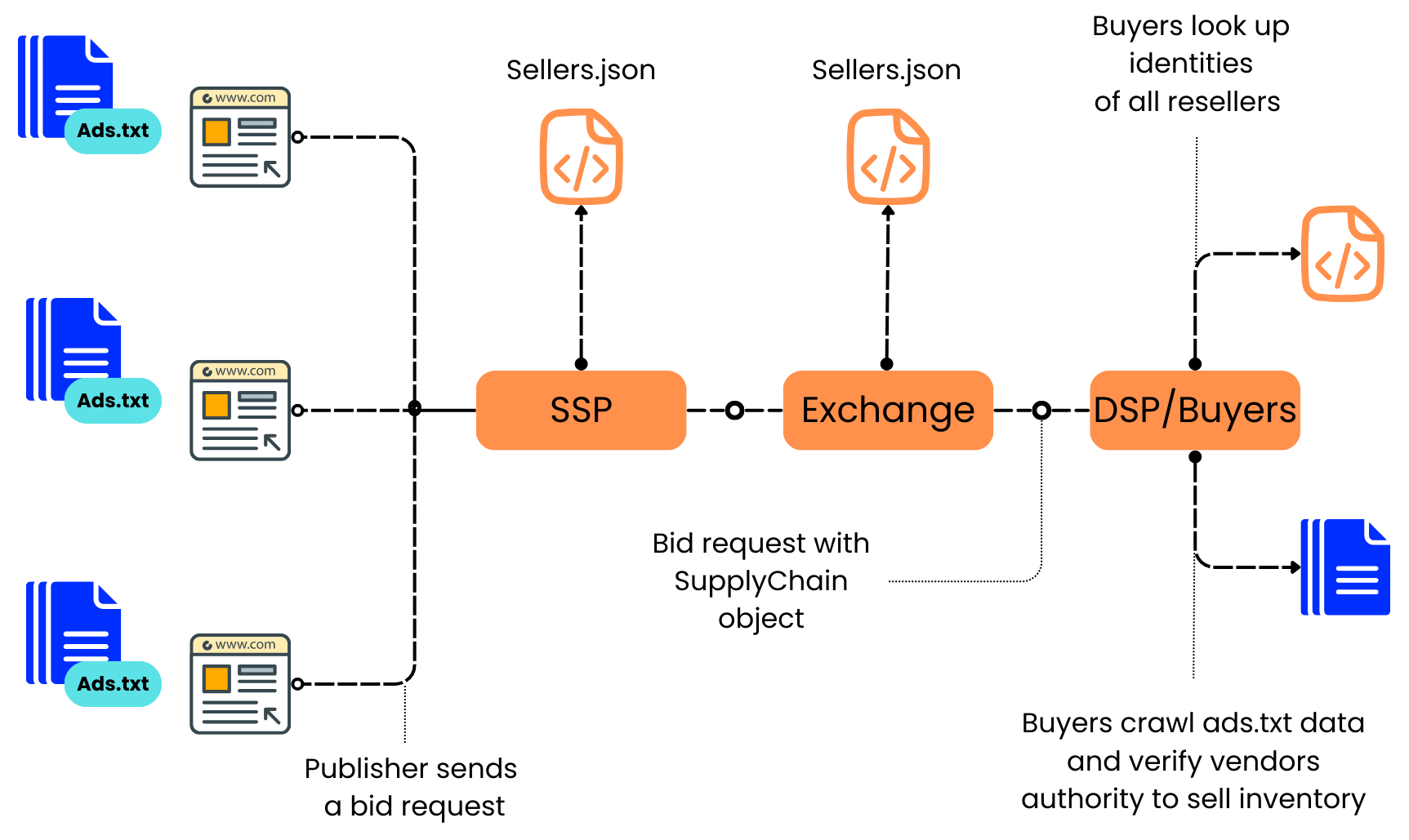
image source:PubPower
- Publisher sends a bid request.
- Buyer receives bid request & data from the SupplyChain object.
- Buyer reviews the identities of all intermediaries.
- Buyer crawls and verifies vendors authorised to sell inventory.
The core standards are below – we have also listed ‘who does what’ with each standard in the table, along with some links to working examples:
|
Standard |
Purpose | Key Features | Integrations | Impact on Transparency |
|---|---|---|---|---|
|
ads.txt & app-ads.txt (created & hosted by publishers) News Corp AU example is here |
Declare authorised sellers of publisher inventory to prevent unauthorised reselling and fraud. |
Public text file listing seller IDs, relationships (direct/reseller), and optional variables such as OWNERDOMAIN. Readable by humans and crawlable by machines for aggregation purposes. |
Complements sellers.json by providing authorisation lists that buyers cross-reference with SupplyChain object nodes. |
Enables buyers to verify inventory authenticity, reducing spoofing; aggregators update lists regularly for marketers. An open-source crawler is available on GitHub. |
|
sellers.json
(created & hosted by SSPs & prog. vendors) PubMatic example is here |
Disclose seller identities and relationships in a machine-readable format. |
JSON file hosted by SSPs & exchanges, listing seller IDs, names, domains, and types (publisher/intermediary/both). |
Used to verify nodes in SupplyChain object & allows offline caching to slim bid requests. Works with ads.txt for end-to-end path validation. |
Provides visibility into intermediaries, helping buyers avoid unwanted hops and confirm final sellers. |
| SupplyChain Object (used by buyers via a DSP) | Traces the full path of entities in a bid request within OpenRTB protocols. | Object in OpenRTB bid requests, listing ‘nodes’ (entities) from start to end, including seller IDs and payment status. | Propagates data from ads.txt and sellers.json through the chain, so that buyers can verify against these files. | Offers real-time insight into resellers, enabling path optimisation and fraud detection. |
| ads.cert | Adds a level of cryptographic security to supply chain interactions. | Protocol for authenticated connections and tamper-proof signals. | Enhances verification of the SupplyChain object and related files. | Bolsters trust by preventing tampering & supporting secure transparency. |
|
Buyers.json & DemandChain Object (buyers.json is created & hosted by DSPs) |
Mirrors sell-side transparency on the buy side to address malvertising. | Disclose entities in ad creation & distribution. | Complements supply-side tools for full ecosystem visibility. | Extends transparency to demand paths, ensuring balanced accountability. |
The adoption of these core transparency standards has now grown significantly enough to be declared to be ubiquitous, with all of the popular ad tech vendors and large platforms (such as Google & Amazon) now integrating them into their systems. However, it’s also worth noting that ads.cert and the buy-side specs still remain lightly adopted, but it is important to be aware that they are available and understand the potential benefits.
The design of these standards is to enable buyers to be able to easily validate their inventory by automating the matching of data from a bid request (using SupplyChain Object) against data from the publisher (using ads.txt or app-ads.txt) and also ad tech vendors (using sellers.json). This provides full insight into all the seller accounts a bid request has passed through on the way to the buyer, showing exactly which entities were involved in the sale of a specific impression and where the related payments have flowed.
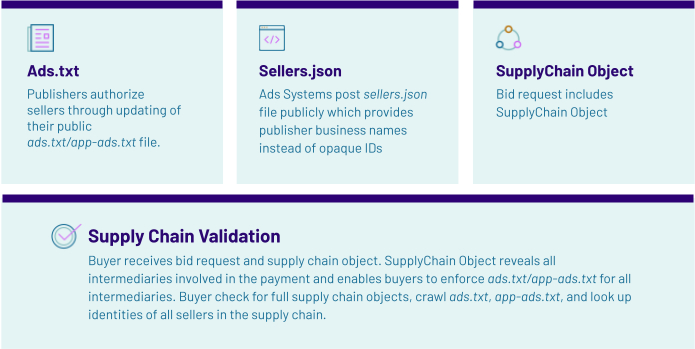
image source: Human
The effectiveness of these standards are only as good as the level of understanding, competent adoption and commitment to the benefits that these standards and their usage can enable. We reiterate our regular recommendation that these be mandatory within all SSPs, DSPs and Ad Exchange vendors, and that agencies and clients be made better aware of how they function and why they are so important from both an insights & brand safety perspective, but also a commercial perspective.
- Benefits for buyers – boosts campaign efficiency through informed decisions on high-quality placements, surfaces the exact sellers involved for auditing purposes, and reduces fraud exposure by enabling verification of seller legitimacy.
- Benefits for sellers – enhances trust and credibility as legitimate sellers within the ecosystem, enables greater controls over sales partnerships, and reduces fraud risks by identifying and excluding any bad actors.
- Benefits for all – adoption builds trust for all parties, enabling more efficient and sustainable buying and establishes simple operational free standards that enable full transparency in programmatic activities, whilst also helping with the relentless fight against fraud.
Also, it’s worth noting that a draft proposal has recently been published (click here) to evolve OpenRTB’s relance upon JSON to using Protocol Buffers (Protobuf) as it’s much more efficient. This should better streamline integrations, reduce maintenance overheads and improve the overall speed and efficiency of programmatic advertising transactions – enabling the industry to focus more resources on product innovation.
This will be a core part of the communications related to the refreshed AdTech Transparency Framework project that our Executive Technology Council is currently working on, to be published in December 2025.
The Draft MRC Digital Advertising Auction Transparency Standards
These MRC draft standards (published in September 2025) are a collaborative effort involving the MRC, Omnicom, ANA, WFA, 4A’s & IAB Tech Lab to create an industry-wide framework designed to enable improved transparency into how ad auctions work.
These standards apply to all types of digital ad auctions, including display, video, audio, search, social, retail media, streaming CTV, and addressable TV – and are designed to supplement the existing OpenRTB protocols.
The IAB Tech Lab Sell-Side Transparency Specifications (see above) play a central role operationally in the recommendations, which have been drafted with the aim to help:
- Enhance transparency in digital ad auction rules and practices.
- Standardise the reporting of auction variables and outcomes.
- Develop a collaborative framework for independent audit and verification.
There are seven core sections to these draft standards, as listed below. We’ll briefly go through each section in turn…
- The Two Types of Ad Auctions
- Requirements for All Auctioneers
- OpenRTB Ad Auctioneer Requirements
- Closed-Loop Ad Auctioneer Requirements
- Winner Determination
- Reporting & Disclosure Guidance
- Auditing Guidelines
The Two Types of Ad Auctions
An ad auction is defined as a competitive bidding system that allocates impressions and sets prices based on factors like bid amounts, ad relevance, and quality. However, the framework then distinguishes between ‘closed-loop’ auctions and ‘open programmatic’ auctions. Closed-loop environments are defined as proprietary systems that are operated entirely by large social media or search platforms, where limited information is available (aka ‘walled gardens’). Open programmatic auctions are executed by the more traditional open internet entities, which leverage the OpenRTB protocols for real-time bidding between DSPs and SSPs.
Open Programmatic Auctions
These use the OpenRTB standard where bid requests, bids, and auction outcomes are shared between demand-side platforms (DSPs) and supply-side platforms (SSPs). These represent a smaller but significant portion of auction volume.
Closed-Loop Auctions
The majority of auction-based media spend occurs through closed-loop systems where all functions are hosted entirely by platform auctioneers like Google, Meta, TikTok & Amazon. Users of these systems typically have less transparency into auction-based operations.
Requirements for All Auctioneers
All ad auctioneers (regardless of auction type) are required to have formal oversight covering auction processes, participant qualification, creative standards, supply qualification, and compliance with regulation and privacy.
Best practices dictate clear documentation, periodic policy verification, independent measurement, and third-party data availability. Requirements expand for OpenRTB-based auctions, emphasising transparency and standardised identification.
The use of standardised industry creative format and ID frameworks is recommended – such as the IAB Tech Lab’s Ad Creative ID Framework (ACIF), which involves ad registries for consistent identification of ad creative in the supply chain. Work on establishing a registry and processes for this is currently underway here locally in Australia.
OpenRTB Ad Auctioneer Requirements
OpenRTB are the IAB Tech Lab protocol for programmatic ad auctions. The MRC standards encourage use of key OpenRTB fields such as the ‘Transaction ID’, ‘Global Placement ID’, and ‘SupplyChain object’ (see article above) – and highly recommended the support for multi-bid and podded-bidding, and accurate reporting across the digital supply chain, further facilitating transparency and third-party measurement.
Note that closed-loop platform auctions do not utilise OpenRTB.
Closed-Loop Ad Auctioneer Requirements
For the proprietary platform (walled garden) closed-loop auctions, specific guidelines cover auction type disclosure (i.e. first-price, second-price), use and reporting of reserve prices, and clear winner determination processes.
Also, all auction participants must understand all bid-modifying variables and their impacts on outcomes. Dynamic pricing factors, pacing, and reporting practices should be fully transparent and documented.
Winner Determination
In basic auction rules, the highest bid wins. However, factors such as demand priority, seller rules, ad quality, context, and relevance often influence winners beyond simply price (similar to nominal-to-effective bid conversions). At a minimum, it’s recommended to disclose and report these variables and their weightings to help buyers and sellers understand any win/loss reasons.
Also, revealing the methods for creating variables such as ad relevance and quality – and be prepared to report upon any applied values. Finally, disclose direct deals or managed buys that override auctions, and can cause losses despite higher bids.
Reporting & Disclosure Guidance
Auction results should be made available to participants in usable, machine-readable formats, supporting line-item granularity and clarity on any bid factors, pricing, and win/loss reasons. Reporting requirements should allow for sampling to manage computational costs, with clear disclosure and operational rules subject to audit.
Additionally, auctioneers are expected to proactively disclose models, adjustment methods, and any changes to auction rules or processes. Comprehensive user guides and formal change notification policies should be supplied, including impact assessments. Error and variability in models or outcomes should be quantified and disclosed.
Auditing Guidelines
Independent, 3rd party audits are encouraged for all auction operators, both for closed-loop and OpenRTB systems. Certification recommendations are also provided – promoting annual compliance audits and broader industry adoption of these standards (even if voluntary).
The document also has a very useful glossary at the end, which defines key terms such as ad auction, auctioneer, auction participant, various auction types, bid factors, and price floors, ensuring consistency of meaning across the various industry stakeholders.
Recommendations for Buyers & Sellers
Ultimately buyers will benefit from clearer insights into bid factors and loss reasons, enabling better strategies and potentially fairer pricing. We recommend that buyers:
- Engage with DSP partners to ensure that they can leverage insights via the SupplyChain Object and start reviewing the supply paths and supply partners.
- If the DSP partner can’t support OpenRTB v2.5+ with schain parsing, then buyers should advocate for updates or else switch to a compliant platform.
- Automate the validation processes of fetching info from sellers.json (for identity) and then crawling and matching with the info from ads.txt (for authorisation). By matching ads.txt data against sellers.json entries, buyers can ensures the validity of any ads.txt entries.
- Automate verification processes in DSPs to handle high-volume auctions, rejecting bids with incomplete chains, excessive hops, or mismatches.
- Establish rule-based auditing and verification processes that can work both as real-time checks and also as post-bid reviews.
- Optimise and evolve bidding strategies based upon these insights and look to combine other OpenRTB signals (e.g. transaction IDs) to improve decisioning.
- Monitor and regularly review the results and iterate accordingly.
- Work more closely with preferred supply partners to maximise efficiencies and ensure as much data is shared from their side as possible on an ongoing basis.
- Consider leveraging IAB Tech Tools such as the Supply Chain API to assist with crawling ads.txt and sellers.json files (click here). IAB Tech Lab regularly crawls millions of websites in order to provide this service.
Meanwhile, sellers gain from standardised supply qualifications, reducing fraud and enhancing inventory value. We recommend that sellers:
- Ensure all domains have an updated ads.txt file, and all apps have a developer domain with an app-ads.txt file linked in their app store page.
- Regularly review the authorised sellers listed and ensure the correct OWNERDOMAIN variable is set.
- Check that the ads.txt file(s) are accessible by all crawlers.
- Ensure vendor partners support OpenRTB v2.5+, can propagate transparency signals and all bid requests will include populated SupplyChain objects for real-time validation purposes.
- Review all vendor partners sellers.json files are setup correctly and validate that the relevant info in your ads.txt and/or app-ads.txt files are correctly matched.
- If you are a reseller of supply you do not own, then you must also create and host a sellers.json file with the ‘seller_type’ field set to INTERMEDIARY.
- Include complete schains to all bid requests (populate ‘source.ext.schain’ with ver, complete flag, and nodes array – & append nodes sequentially).
- Simulate bid requests to fully test chain integrity and if possible leverage buy-side tools for full verification purposes.
- Advocate for adherence to transparency standards in contracts with all downstream partners (and in thought leadership articles!).
- Consider leveraging IAB Tech Tools like the ‘Supply Chain Validation for Sellers’ (click here).