
IAB Australia’s 9th annual MeasureUp, themed Driving to Outcomes, explored how marketing connects to business and societal results. Across keynotes, panels, and case studies, MeasureUp presenters shared practical approaches to modernising measurement in an increasingly complex environment.
Huge thanks to our sponsors Cint, Dynata, Google, IAS, Meta and SambaTV for their commitment to bringing this community together to share ideas and push the industry forward.
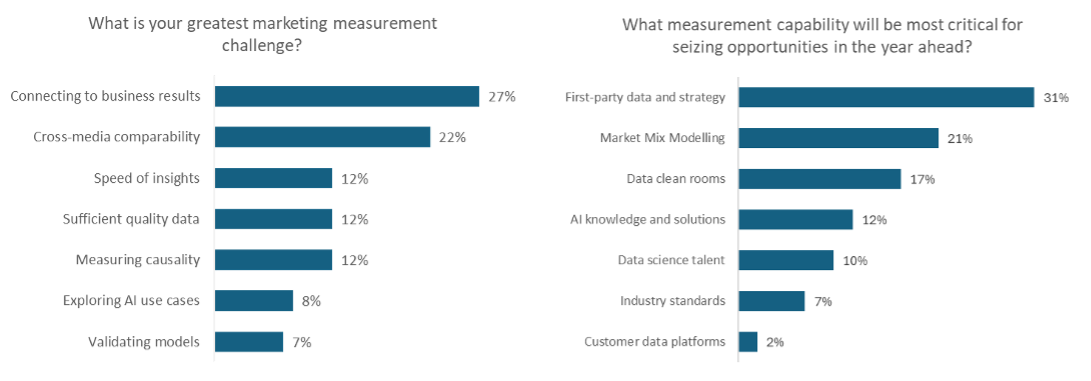
Cint sponsored our MeasureUp audience polls conducted during the event and these revealed that having measurement in place that connects to understanding business results is one of the biggest current challenges. First-party data, Market Mix Modelling and data clean rooms were also thought to be amongst the most important measurement capabilities needed for seizing opportunities in the year ahead according to our MeasureUp audience.
Key Sessions & Insights:
Angelina Eng (IAB US) outlined progress on standards, taxonomies, and tools like the Ad Creative ID Framework, while noting that siloed data and outdated models remain barriers. She urged the industry to harmonise metrics, adopt hybrid approaches combining attribution, incrementality, and MMM, and collaborate on scalable, ethical solutions.
A buy-side panel (Liam Loan-Lack, Keystart; Matt Cranley, Superloop; Cameron Webb, TPG; Lillian Zrim, PHD) discussed what modernising measurement means in practice and stressed proving incremental impact, not just inputs. The panel highlighted the role of analytics in steering growth, fit-for-purpose methodologies, privacy compliance, and the importance of Market Mix Modelling, vendor selection, and validation.
Liam Loan-Lack from Keystart said “If I was to give you an extra 10% marketing budget, or in the sad reality for many marketeers, if I was to cut your budget by 10%, how much incremental impact or loss would that result in? Rather than talking about the widgets and the inputs into it, if you can answer that question with a high level of confidence that, to me, indicated how well developed your approach is”.
Xue Ying Chen (WPP Media) and Arum Nixon (Ad Net Zero) showed how optimising toward low-carbon, high-performance inventory cut 5.5 tons of emissions across 31 campaigns while lifting performance by 15%. They showed how clients carbon emissions can reduce overtime by using a combined weighted score of client campaign KPIs and emissions data in the DSP to optimise campaign to inventory. Find out more on The Global Media Sustainability Framework (GMSF).
Avik Dala (Meta), Trent Durfee (Annalect) and Raphael Ferraz de Campos (PepsiCo) explored data clean rooms as privacy-conscious solutions for richer, more actionable insights. The ability to leverage first-party data alongside publisher data to gain actionable insights while maintaining consumer privacy was emphasised.
Andy Ford (Coles360) with Barry Collins (Circana) warned against over-reliance on ROAS, discussing incrementality tools using synthetic controls and modelling. In a panel discussion on proving performance across the funnel and channel, moderated by Lela Richmond-Johnson (Criteo), panelist Alison Silver (Pepsi Co) explained that incrementality can look different depending on category.
Daren Poole and Shagnik Lahiri (Ipsos) shared Gen Z insights, stressing digital nativity, authenticity, trust, and social responsibility as drivers of purchase behaviour. Deep understanding of Gen Z was at the heart of successful ad creative examples shown targeting the first truly digital generation. Download the Ipsos iris Gen Z insights report.
Sharon Hilton (Kantar) and Alysha Calder (Nine) showcased the "Stop it at the Start" campaign against domestic violence, highlighting the collaboration with the Australian Government to amplify the message across multiple media channels. It stressed the power of trusted personalities, high-impact creative, and a coordinated cross-channel approach to drive reach and effectiveness.
Jonathan Munschi (The Trade Desk) and Maria Gudino (Unilever) quantified the value of integrated omnichannel marketing, showing how managing messaging, frequency, and sequencing across channels boosts engagement and effectiveness. Research demonstrated that cohesive strategies significantly enhance campaign impact. Download The Trade Desk Omnichannel Edge Report.
Luke Fielding (Eftsure) & Will Sherbon (LinkedIn) shared a compelling B2B case study outlining Eftsure’s international growth journey, showing how measurement links brand building to revenue outcomes.
Andreea Chirila (Kantar), Jon-Paul Stift (TikTok), and Rory Turley (Tinder) shared how Tinder’s Share My Date campaign won Kantar’s global Brand Blueprint Award for shifting perceptions among single Aussies. The campaign highlighted in-app trust and safety features with authentic, relatable creator-led content.
This year’s MeasureUp event put a spotlight on how organisations are rethinking marketing measurement to reflect the complexities of modern media and make faster, smarter, and more inclusive decisions. The conference yet again provided the market with new data from a wide range of studies to help inform and improve measurement in our local industry. We hope it helped our audience on their journey towards actionable measurement.
You can check out all the content from the day on the MeasureUp page here.
See you in 2026 for MeasureUp’s 10th year!