
This week we take a look at the two recent updates from IAB Tech Lab
- Guidance on ID-Less Solutions.
- Several releases focused on helping the industry leverage taxonomies to support CTV genre values.
ID-Less Solutions Guidance
In September this year our Data Council published the ‘Identifiers Explainer Guide and Matrix: 2024 edition‘ (click here) as an update on key related latest standards and best practices – and also to update the list of the most prevalent local ID solutions, what they offer, how they differ and showcase the most common major matching & activation services available.
Our intent was for both buyers and sellers to have more confidence in making decisions related to how to approach leveraging these solutions. This guidance includes the consolidation of the PAIR & OPJA protocols and also key OpenRTB updates to enable improved transparency on identifier sourcing and application within the bidstream.
To further support this growing space and reduce confusion surrounding ID-less solutions, IAB Tech Lab have now published ID-Less Solutions guidance. This guidance offers clear distinctions between traditional and ID-less approaches, outlines key use cases, and provides a roadmap for stakeholders to evaluate emerging technologies. The document not only highlights the functional and technical capabilities of ID-less solutions, but also frames them in the broader context of privacy and addressability.
Clear definitions and insights into the differences between ID-based & ID-less solutions are provided and very usefully broken down by different uses cases (see some examples below) across a wide range of different requirements.
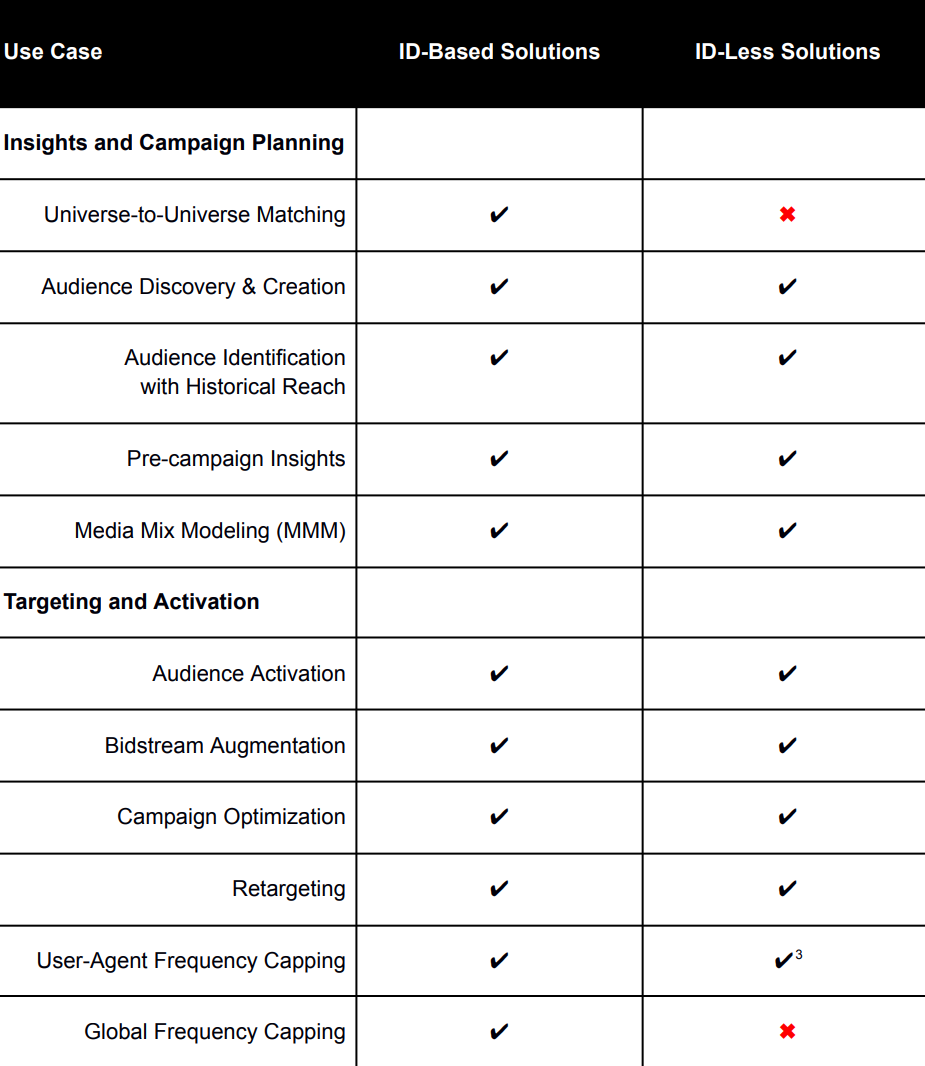
The different technology requirements are also included, along with how to manage key operational requirements such as Frequency Capping, Fraud Mitigation/Detection and Retargeting.
Other areas of focus include:
- What is the scale of environments where identifiers are not available.
- Using Shared Storage for frequency capping, creative selection.
- Using Private Aggregation API for measurement, reach estimation.
- Using Topics, Seller Defined Audiences, Interest Groups, Cohorts within programmatic advertising.
We highly recommend reviewing this draft guidance, and feel free to provide feedback during the public comment period (open until December 19, 2024). To access the document simply click here
Programmatic CTV Genres
A range of releases related to taxonomies have been pushed out by IAB Tech Lab which includes updates to better support labelling of CTV content for programmatic.
Developed by IAB Tech Lab’s Taxonomy & Mapping Working Group and the Programmatic Supply Chain Working Group, the new guidance includes:
- New OpenRTB attributes
genresandgtax. - Minor update to genres list, releasing as Content Taxonomy 3.1.
- Subset of Content Taxonomy 3.1 for CTV Genres and Implementation Guidance.
- Content Taxonomy 1.0 → Content Taxonomy 2.0 Mapping and Implementation Guidance.
- Bi-directional mapping of Content Taxonomy 1.0 and Ad Product Taxonomy 2.0 and Implementation Guidance.
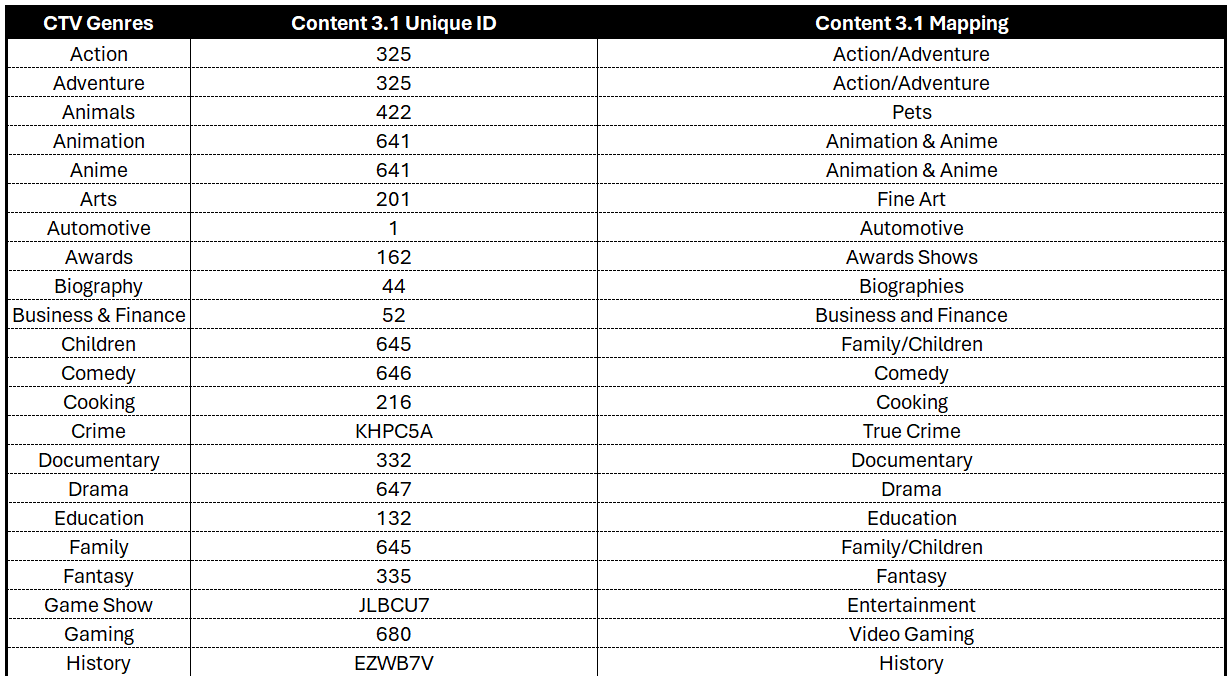
However, to fully appreciate the importance of taxonomies in digital advertising useful guidance on these have also been published to help build awareness, the link to an excellent blog article is at the bottom of this page. In summary:
Importance of Common Industry Taxonomies
A bit like organising books in a library into simple genres, taxonomies help sort data or concepts into categories so everyone across the industry uses the same terms.
Why Are Taxonomies So Important?
- Clear Communication: Without these, everyone might use different words for the same thing, leading to confusion.
- Easier Data Sharing: They make it simpler to match and use data from various sources without mix-ups.
- Growth & Efficiency: Helps scale operations as new partners or technologies are added without starting from scratch each time.
- Privacy & Rules: Helps manage data correctly under privacy laws.
IAB Tech Lab manages four distinct taxonomies designed to enhance efficiency, reduce inefficiencies in the bidstream, and promote industry-wide adoption of standardised classification systems. They also incorporate privacy considerations to minimise any risk of generating or using sensitive personal data in contextual or curated ad campaigns.
Content Taxonomy
This provides a common language that can be used when describing content. Typical uses of the content taxonomy are contextual targeting, curated campaigns and brand safety. The lates (3.1) version of the content taxonomy contains an update to the genre categories for CTV.
Audience Taxonomy
Historically, data vendors, DMPs and analytics providers have used custom taxonomies to describe and segment their audiences, with little or no standardisation across vendors. This results in sometimes drastically different descriptions even for similar data. Comparability is also made more difficult due to the fact that in house taxonomies reflect a wide range of audience segmentation approaches, including demographic (age, gender, household income, etc.), interest-based, purchase-intent based, psychographic, and many more. With the introduction of IAB Tech Lab’s Audience Taxonomy, the industry now has a common nomenclature for audience segment names to improve comparability of data across different providers.
Ad Product Taxonomy
Launched in July 2022 to establish a standardised nomenclature for describing the product or service being advertised. It aims to provide publishers with stronger control over the types of ads that get delivered via automated channels
Privacy Taxonomy
Launched in September 2024, this provides a consistent language for defining, classifying, and communicating personal data, designed to standardise the way privacy and governance-related data elements, purposes of data use, and subjects are labeled and described. The Privacy Taxonomy provides an interoperable standard designed to assist businesses in navigating the complex landscape of global privacy regulations.
What Are the General Benefits of Using Taxonomies?
- Better Targeting: Ads can be more accurately placed based on content or user interests.
- Transparency and Trust: Everyone knows exactly what they’re dealing with, reducing misunderstandings.
- Efficiency and Cost Savings: Less time and money spent on sorting out different systems.
- Interoperability: Makes it easier for new tech or partners to work together without custom solutions.
How Do Different Ad Industry Participants Use Them?
- Publishers (Website Owners) can label their content for better ad placement.
- Advertisers get consistent ways to reach their audience across platforms.
- Tech Companies benefit from easier system integration.
To review this guidance further simply follow the links below.
Content Taxonomy 1.0 to Content Taxonomy 2.0 Mapping
Lastly, a mapping solution has been developed to remove the barrier to moving on from older content taxonomies (i.e. Content Taxonomy 1.0) as upgrading to a new taxonomy involves many moving parts, such as relabelling content already labelled in the previous taxonomy, upgrading UIs and retooling existing workflows and operational strategies.
Publishers and DSPs who have been using Content v1.0 to describe their sell-side content inventory, ad verification vendors and brand safety/suitability providers who have been using Content 1.0 to describe digital content and anyone with similar use cases and digital content should review this mapping.
On the other hand, advertisers and DSPs who have been using Content 1.0 to categorise ads should move to Ad Product Taxonomy 2.0 which was created to describe the product categorisation of an advertisement.
For more information on this, simply click here