Media owners selling ads online are a critical and integral part of our digital ads ecosystem as traditional suppliers of audiences, content-based experiences and the related ad opportunities for marketers.
However, enabling and delivering these ad opportunities generate carbon emissions through activities such as servers delivering ads, the computational efforts of auctioning ad spaces and leveraging power from user devices and/or web browsers in order to to display them.
The GMSF, created by Ad Net Zero, is a free, voluntary set of industry frameworks established to help industry measure and reduce carbon emissions generated.
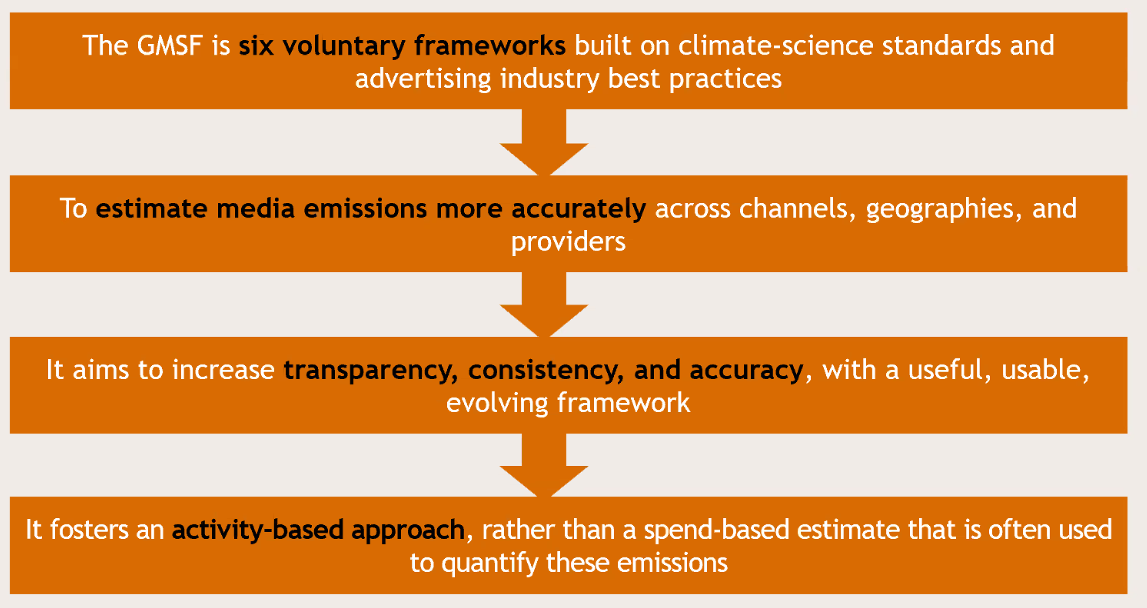
As a playbook the GMSF designed to try and simplify the complex with formulae, data guides, and tools to estimate greenhouse gas (GHG) emissions consistently and accurately, without bias towards any specific channel or provider. Digital is the most advanced of the channels / environments included, which gives us the opportunity to provide some guidance sooner rather than later.
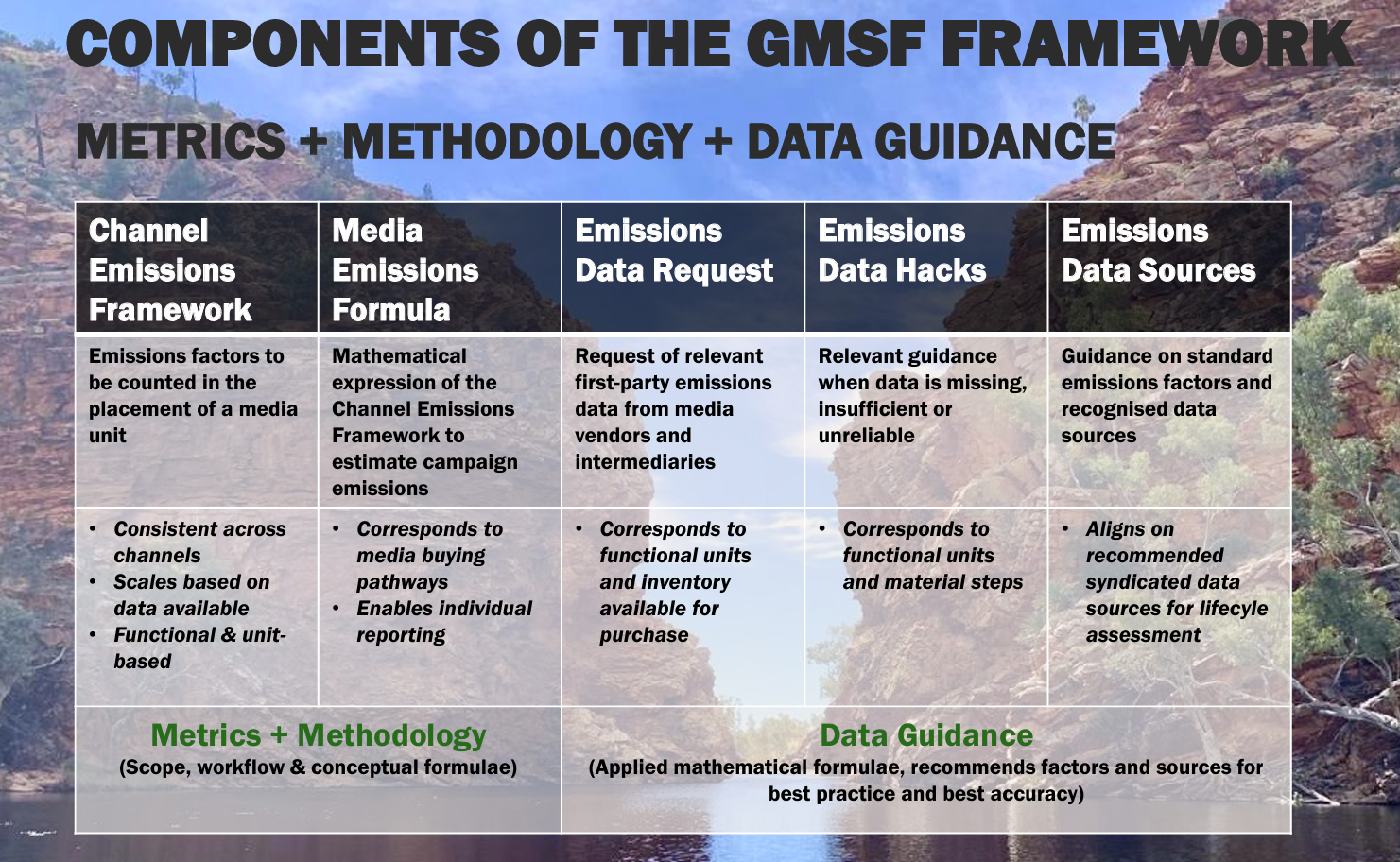
The intention of this explainer for digital publishers, is to provide a basic summary of this guidance from a media owners’ perspective, break out clearly the different phases of activities that can be calculated and lastly provide some example calculations of very basic campaigns (both direct and programmatic) for display and video advertising. We will also look at publishing some buy-side guidance in the coming weeks.
Lastly, we’ll also include some basic recommendations for reduction that most AdOps team members can leverage as well as links to other related guidance and further research.
The six sections of this explainer are:
- Introduction – The Three Key Phases.
- Emissions Calculations – The Focus Areas.
- Some Considerations & An ads.txt Refresher.
- The Three Formulae & Three Types of Inputs.
- Three Example Calculations For Both Display & Video Campaigns.
- Basic Suggested Reduction Tactics.
We hope that this guidance will give publishers the confidence to respond to any sustainability related requests from their buying clients (both agency and direct clients) but also enable them to proactively communicate that they are now actively estimating emissions and can share the operational best practices that they are following in order to minimise the carbon emissions wherever possible.
We hope that you find it useful… please feedback as you see fit.
Introduction – The Three Key Phases
From a publisher perspective, the GMSF emissions workflow focuses on three key phases: Creation (storage & manipulation of ad assets) , Distribution (ad serving and ad opportunity selections enabled via auctions in programmatic, and creative delivery over networks) and Consumption (user devices rendering the ad).
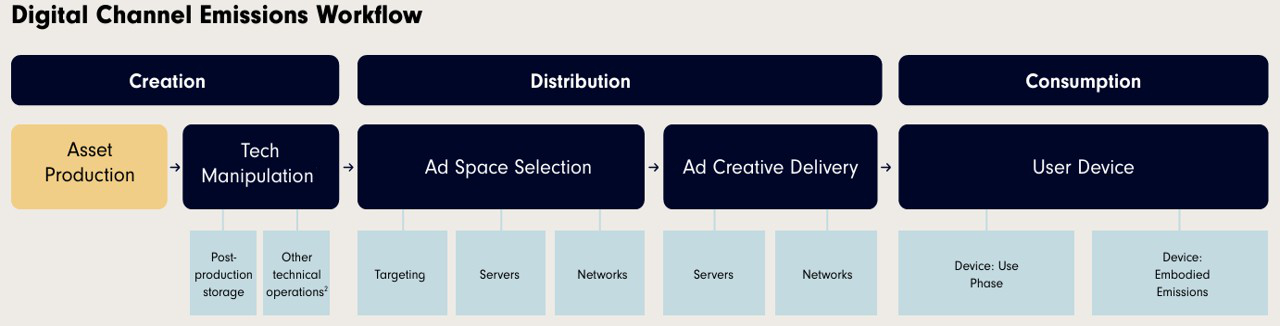
Creation (partially) – publishers generally have creative guidelines for ad assets and should have autonomy over the storage of assets and any usage of ads delivered by third-party ad code to their audiences. For IAB Australia’s foundational guidance on this CLICK HERE
Distribution – the ad space selection, any additional ad opportunity decisioning enabled via programmatic auctions, and ad asset delivery. Emissions are calculated in kg CO2e.
Consumption – types of user devices and web applications ultimately loading, streaming and rendering the ad. This is calculated using real-world data such as ad impressions, file sizes, and electricity grid factors to calculate emissions in kg CO2e.
It is only really the phases of Distribution and Consumption that are most critical for any calculations, but there are some basic tips for reduction during the Creation phase which we will include in this explainer.
However, before we look at these phases in more detail we need to define what kg CO2e is.
Note – what does kg CO2e mean?
Carbon Dioxide Equivalent (CO2e) is the unit of measurement for the warming effect of greenhouse gases, and allows one to compare and equate the effect of different greenhouse gases into a singular climate footprint. The exchange rate itself expresses how many kg of carbon dioxide emissions warm the climate equally as 1 kg of another greenhouse gas, over a certain period of time (most often 100 years). CO2e translates the potency, how much infrared radiation a ton of each gas absorbs, and longevity, how long a ton of each gas radiates the heat back to the atmosphere, in relation to the emissions of a ton of carbon dioxide.
Emissions Calculations – The Focus Areas
From a publisher perspective for the GMSF emissions calculations we focus on three key areas: Ad Space Selection, Ad Creative Delivery and the User Device. We’ll look at each in turn.
- Ad Space Selection – ad creative selection, targeting & programmatic auctions decisioning based upon the potential number of active paths per impression and the related infrastructural power required & associated resulting emissions. The active paths for direct and programmatic guaranteed are fixed (2 severs = 4 ad calls). For programmatic (auction-based) decisioning the calculations are based upon the potential number of active paths per impression (using the number of authorised sellers in the publishers ads.txt file).
- Ad Creative Delivery – this is the level of effort required for the serving of each creative asset, based upon location and asset type.
- User Device – this is the level of effort required by devices to load/stream and render a creative asset to the user, based upon device type (this can be specified or else the average device mix by country is used) and location.
However, before we dive into these three focus areas for emissions calculations, let’s quickly review some key considerations and review the publisher ads.txt files (for programmatic activity).
Some Considerations and ads.txt Refresher
In order to make the D.I.Y. calculations process manageable, for both buyers and sellers, there are a number of logical assumptions made to help simplify the process. These are:
- Unless specified, all display ad unit sizes are treated equally in terms of weight & related payloads. One can amend the related weights manually however should the display ad be particularly heavy (e.g. skins / heavy rich media), and we will look at these types of manual ‘tweaks’ in this explainer.
- Unless specified, average device distribution for consumers is calculated per country. For Australia this is Mobile 61%, Tablet 4%, PC 18%, CTV 17%, and again this can be manually ‘tweaked’ should the targeting be device specific.
- Specific targeting attributes enabled by in-house data or via data partners are not included in this version of the GMSF.
- Calculations for programmatic campaigns use the number of lines within a publisher’s ads.txt file and are treated as ‘paths’ between programmatic partners authorised to sell publisher supply. An estimate for activated programmatic ‘paths’ is used to calculate the associated successful requests and responses – and ultimately the resulting emissions. A refresher on ads.txt is below.
- IO-based campaigns and programmatic direct /guaranteed are treated equally in terms of effort (i.e. only 1 ‘path’, 2 servers, 4 ad calls).
An ads.txt Refresher
ads.txt stands for ‘Authorised Digital Sellers’ and is a simple, secure, and flexible text-file based mechanism for publishers and authorised partners to publicly declare the companies they have sanctioned to sell their digital inventory.
Publishers post the “/ads.txt” file on their root domain and any subdomains as needed and these files can be easily read by both humans and machines. It’s worth noting that this standard exists also for apps (app-ads.txt) as an extension.
Some ads.txt files are simply a long list of authorised sellers with each seller account ID listed as an individual line or potential ‘path’ for programmatic transactions. For an example of a fairly long list (over 2,000) see www.boredpanda.com/ads.txt
However, an example below is a sample from a shorter and very well organised file (from www.news.com.au/ads.txt) with the list separated by each authorised seller with the individual seller account IDs listed below.
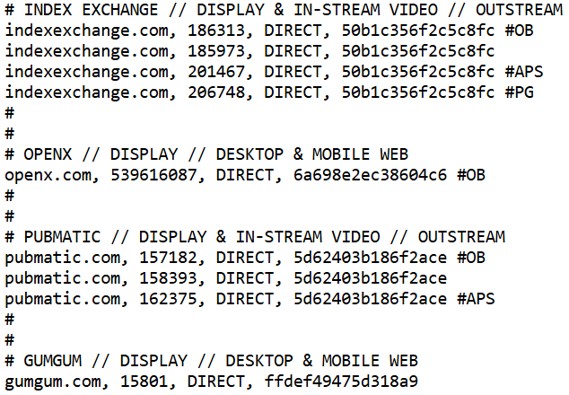
In the list above (which remember, is just a sample), we can view that there are 4 labelled ‘authorised sellers’ with the individual seller account IDs listed below each – 9 in total. Is is the total of 9 lines – which is the number to be used for the GSMF calculations.
For more information on ads.txt simply click here
The 3 Formulae & 3 Types of Inputs
The formulas for Ad Space Selection, Ad Creative Delivery and the User Device can be slightly confronting at a glance. However, within each there are three types of inputs – Required, Default & Emission Factors.
For publishers to estimate emissions at a high-level these can be done very simply with only two required inputs for direct campaigns (impressions & ad asset type) and only three for programmatic campaigns (impressions, ad asset type & total no. of ads.txt lines).
We will briefly define the types of inputs, review the 3 formulas and then further down we’ll look at some simple basic calculations for display & video campaigns – for both direct and programmatic.
The 3 Types of Inputs
Required Inputs (in Red) – are the specific details – impressions, ad asset type & ads.txt lines (for programmatic) – that publishers must provide as they directly affect the emissions calculation. These are unique to each campaign and cannot be assumed.
Default Values (in Orange) – are standard assumptions (‘data hacks’) used when specific data is not available. Based upon local industry averages or estimates from the GMSF in order to simplify any calculations. These can be tweaked if required.
Emissions Factors (in Green) – are fixed scientific measurements that enable the conversion of all the computational efforts, energy use and/or data transfers into meaningful carbon emissions (kg CO2e). These reflect how much electricity or hardware contributes to emissions.
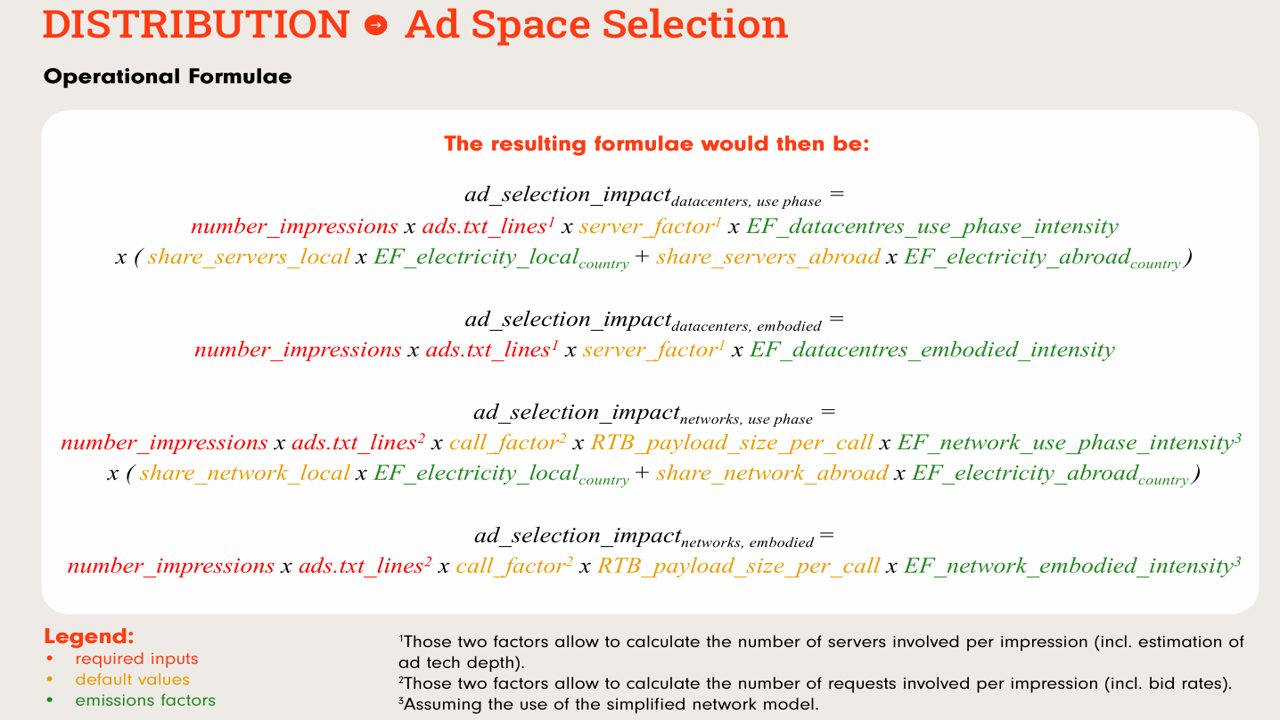
Ad Space Selection Formula
For these calculations (at a high-level) for direct campaigns, only the number of impressions are required.
For programmatic it is required to also include the total number of ads.txt lines.
For programmatic auctions an estimate is used related to the number of ‘active paths’ from the ads.txt lines (no. of servers & ‘network’ ad calls) because not all bid requests are responded to, hence an average is used.
Emissions from digital ad campaigns can vary between different states in Australia due to differences in the electricity grid emission factors. South Australia for instance, has a high proportion of renewables, leading to a much lower grid emission factor when compared to other states. This could be a ‘tweak’ to the orange inputs depending upon where servers are located (the default assumption is 50% AU, 50% global).
For more information on Australian Data Centers simply CLICK HERE
Lastly – a note on platforms (or ‘walled gardens’) as less information is openly available. As such, the GMSF digital methodology would simply require an estimate for the number of activated servers – for instance IAB Europe’s ESG Methodology & Framework Working Group recently proposed an estimate of 500 servers.
Ad Creative Delivery Formula
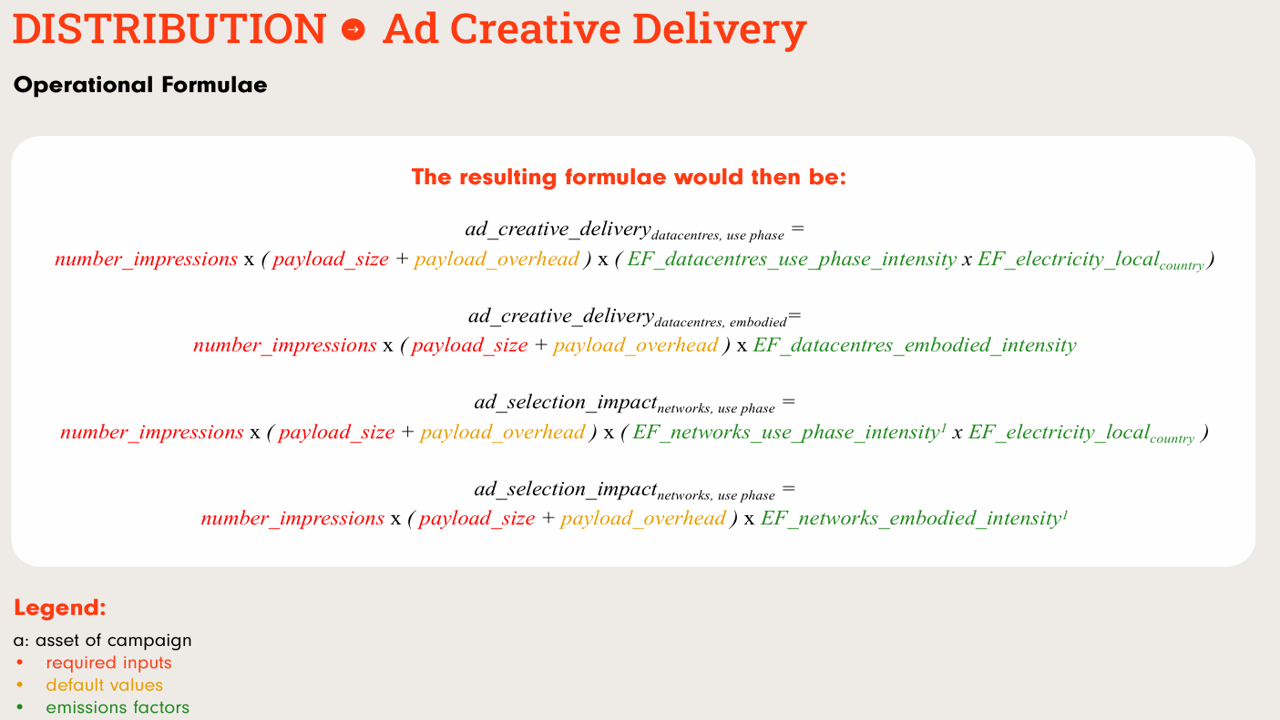
The critical required inputs here are impressions and creative type and the methodology accounts for the ‘payload’ effort due to the weight of the ads assets of the content delivery networks (CDN) and the ‘overhead’ effort from the origin server. There are standard estimates for both display and video for instance, but if these differ dramatically then adjusting the resulting default ‘payload’ and ‘overhead’ inputs is an option.
The industry default for display is 0.3MB (0.25 MB ad weight + 0.05 MB overhead) and the default for video is 2.35 MB (4 MB ad * 50% completion + 0.35 MB overhead). We’ll look at both in our example calculations that will follow.
User Device Formula
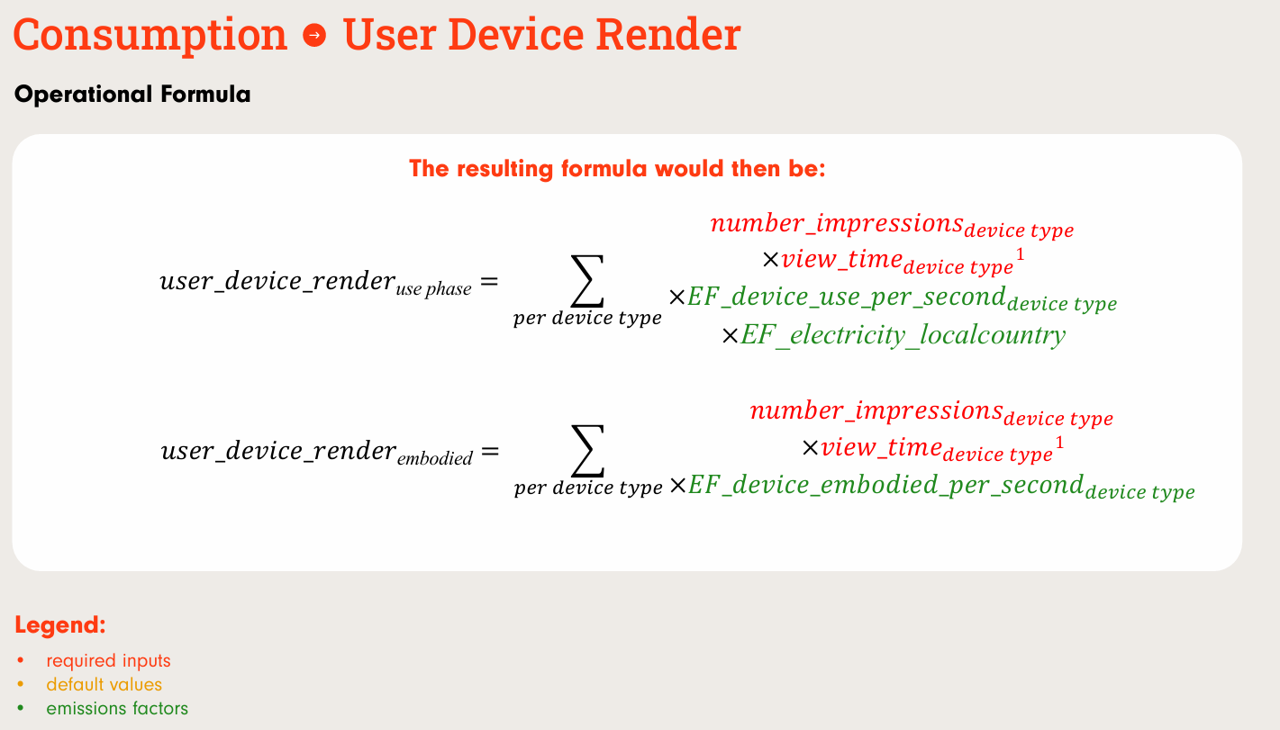
This stage accounts for emissions related to the resource usage on user devices across the four main device types – mobile, tablet, PC & TV. In the absence of specific data it’s assumed that the entire device’s lifecycle emissions are allocated to each digital ad, and that view time can be used as a proxy to facilitate the time-based allocation.
To keep things simple in our example calculations to follow, we use the Australian average view time of 5 seconds for display and 7.5 seconds for video ads. These can be ‘tweaked’ if preferred and if you have the relevant data available.
Three Example Calculations For Both Display & Video Campaigns
We will now create three very basic example emissions calculations using the GMSF for a direct display campaign, a direct video campaign and a programmatic display campaign.
Example 1: Direct (IO-based) campaign – 100k 728×90 display Ads, over 7 Days.
*Note – for direct ad serving, the publishers delivered ads via their own ad server with no programmatic auctions.
Measurement Calculations:
- Ad Space Selection (Distribution): 2 servers = 4 ‘network’ ad calls. Emissions = 0.05kg CO2e (servers: 0.04 kg; ad calls: 0.01 kg).
- Ad Creative Delivery (Distribution): 0.3 MB total payload (0.25 MB ad ‘weight’ + 0.05 MB overhead) per impression delivered. Emissions = 1.15kg CO2e (networks / Content Distribution Network energy & hardware ‘effort’).
- User Device (Consumption): 5 second view time, Average Australia device(s) split (Mobile 61%, Tablet 4%, PC 18%, CTV 17%). Emissions = 6.56kg CO2e (device energy: 2.81 kg; hardware ‘effort to load ad: 3.75 kg).
Total Emissions: 7.76kg CO2e
Example 2: Direct (IO-based) campaign – 100k video ads, over 7 Days.
*Note – for direct ad serving, the publishers delivered ads via their own ad server with no programmatic auctions.
Measurement Calculations:
- Ad Space Selection (Distribution): 2 servers = 4 ‘network’ ad calls. Emissions = 0.05kg CO2e (servers: 0.04kg; ad calls: 0.01kg).
- Ad Creative Delivery (Distribution): 2.35MB total payload (4MB ad ‘weight’ @ 50% completion + 0.35MB overhead) per impression delivered. Emissions = 9kg CO2e (networks / Content Distribution Network energy & hardware ‘effort’).
- User Device (Consumption): 7.5 second view time, Average Australia device(s) split (Mobile 61%, Tablet 4%, PC 18%, CTV 17%). Emissions = 9.84kg CO2e (device energy: 4.21kg; hardware ‘effort to load ad: 5.62kg).
Total Emissions: 18.89kg CO2e
Example 3: Programmatic campaign – 100k display ads, over 7 Days.
*Note – delivered via an SSP, with 100 ads.txt lines (‘authorised seller’ programmatic partners).
Measurement Calculations:
- Ad Space Selection (Distribution): programmatic auctions via ‘active paths’ (141 servers, 146 ‘network’ ad calls). Emissions = 3.02kg CO2e (servers: 2.5kg; ad calls: 0.52kg).
- Ad Creative Delivery (Distribution): 0.3 MB total payload (0.25 MB ad ‘weight’ + 0.05 MB overhead) per impression delivered. Emissions = 1.15kg CO2e (networks / Content Distribution Network energy & hardware ‘effort’).
- User Device (Consumption): 5 second view time, Average Australia device(s) split (Mobile 61%, Tablet 4%, PC 18%, CTV 17%). Emissions = 6.56kg CO2e (device energy: 2.81 kg; hardware ‘effort to load ad: 3.75 kg).
Total Emissions: 10.73kg CO2e
Some Simple Take Outs
- Using the high-level required inputs approach publishers can now very easily calculate carbon emissions for most ad campaigns. Measurement is the start, thereafter reduction practices can follow.
- The intention is to give publishers the confidence to respond to any sustainability related requests from their buying clients (both agency and direct clients) and also enable them to proactively communicate that they are now actively estimating emissions and can share the operational best practices that they are following in order to minimise the carbon emissions wherever possible.
- Note the increase in emissions when comparing the direct campaign (7.76kg CO2e) with the programmatic display campaign (10.73kg CO2e).
Basic Suggested Reduction Tactics
Now that publishers can measure campaign emissions, implementing some simple operational improvements and best practices, and measuring the resulting reduction in carbon emissions is possible.
Some basic tips for immediate actionable reduction are below:
- Optimise payloads by insisting on lighter ad assets in your creative guidelines.
- Implement basic Supply Path Optimisation (SPO) practices such as reviewing and reducing the number of lines of authorised programmatic sellers in the ads.txt file.
- Consider lazy loading (or deferred loading) of your ads. Via lazy loading, websites only gradually render the ads as the user scrolls down the page, rather than bulk loading assets regardless of whether or not a user will actually view that asset (ad and/or content).
- Utilise the most recent features in programmatic standards (from OpenRTB v2.6 onwards) related to ad pods and pod bidding for CTV and long-form video ads.
- Always provide a Bid Floor price for any programmatic campaigns, to ensure that buyers avoid needlessly responding with bids for auctions that they will never win.
- Consider Adaptive Streaming solutions for video. Adaptive streaming, also known as adaptive bitrate streaming (ABR), is a technology which automatically adjusts the quality of a video stream in real-time based upon the viewer’s internet speed, device capabilities, and network conditions. Traditional video ads often send full high-resolution files regardless of the viewer’s connection speed, leading to wasted data, whilst adaptive streaming breaks videos into small segments and dynamically adjusts the quality – making video ads more sustainable without sacrificing performance.
For further reading please see the links below…